Thursday, 14 February 2013

Player Comparison: Ferdinand vs Terry vs Carragher

On the back of Jamie Carragher's retirement announcement last week, I thought I'd revisit the Ferdinand vs Terry player Comparison, and see how the Liverpool hero compares to his peers:


At the time of writing, Jamie Carragher has played 724 games for the Anfield Giants, and if you were to ask most fans of Liverpool who they'd have rather had in their team out of him, Ferdinand, and Terry they'd say Carragher, and most wouldn't even give it a second's thought. Certainly the Liverpool fans I know at least.

So statistically, how did he compare? When looking at the Ferdinand vs Terry defensive stats, there wasn't much in it - Terry was more likely to keep a clean sheet, but Ferdinand was more likely to do it against better opposition. Comparing Carragher to the two multiple title winning defenders isn't going to be completely fair given the quality of the teams the other two have played with - certainly the final league positions, but I thought it might be interesting nonetheless. This will be a shorter one that usual as most two thirds have been covered here.

Premier League

First up is the simple clean sheets against appearances. Terry leads the way in both the number of clean sheets (159) and the rate of clean sheets with one every 1.96. Unsurprisingly Ferdinand has the next best rate as you'd expect from five title winning seasons. However, when looking at Carragher, he actually kept more clean sheets than Ferdinand with 144, and like John Terry, has managed to keep over twenty clean sheets on more than three seasons - a phenomenal achievement.

And like Terry, Carragher kept at least ten clean sheets eight of the last ten seasons, compared to Ferdinands. Take into account Liverpool's average league ranking was 4.7 in that time - with a low of 8th last season. Ferdinand's Man Utd have an average ranking of 1.6 in the same ten year period, and Terry's Chelsea is 2.4.

Moving on to the range of opposition, this looks at clean sheets kept against the Bottom 6, Middle 8 and Top 6 teams:
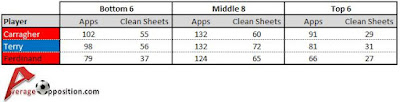

Ferdinand leads the way with the rate of clean sheets against the Top 6 teams in the Premier League with one every 2.44 games, compared to Terry's 2.61 and Carragher's 3.13, though the Liverpool man has achieved two more clean sheets against the Top 6 teams than his Chelsea conterpart.

So whilst Carragher is behind his peers in the games per clean sheet rate, his 2.26 is certainly impressive, although the rate against the Top 6 isn't quite on the same level as the other two - reflected in Liverpool's league positions in the ten years.

It's a similar story on the goals conceded table:


All three have conceded less than a goal a game over the ten years, though the rate drops when taking into account the Top 6 opponents for all three players. 


Champions League

For new readers, the main aim of this site is to identify the Big Game players, and keeping with that theme, the biggest games in club football are in the European Champions League.

Onto the stats - All three players have won the Champions League Trophy and all have suffered defeat in the final. So how do they compare in the big tournament:

Clean Sheets


Conceded
Carragher has played in 10 qualifying games - keeping 6 clean sheets, and conceding just 4 goals as Liverpool safely made it through in the five seasons needed. Moving onto the group stage, where the games are lower pressure and the opponents are in general weaker, Carragher has a decent 16 clean sheets in 36 games - a lower rate than Ferdinand and Carragher, but still a decent return. The big games however can be measured in the knock out games.

Whilst Ferdinand is the clear winner with a clean sheet every two games in the knock out stages of the Champions League, Carragher actually has a much better record than his Chelsea rival - keeping a very decent clean sheet for every 2.77 games, compared to Terry's 3.4 games. In terms of goals conceded, once again it's Ferdinand that has the lowest number per game, whilst Carragher's is just worse than Terry's with 1.1 each (1.07 to 1.12).

So on the big European Stage, Ferdinand is king, but Carragher out performs Terry in terms of clean sheets.

Other

On the Ferdinand vs Terry piece, I looked at Goals scored as a measure. I think it's fair to say that's probably not necessary for Carragher!

However, another measure was the defensive stats in domestic cup finals - another measure of big game players. Whilst Ferdinand has three clean sheets for five domestic cup finals to Terry's two in seven, Carragher's appearances have seen one clean sheet (against Man United) in the League Cup and the 2006 FA Cup Final saw im concede three goals against West Ham (one of which he scored). He does of course have winners medals for the 2001 FA Cup and League Cups as part of their Cup treble - none of which contained clean sheets.

Conclusion

I'll leave this one up to the reader. The stats of course only tell half the story but they're interesting nonetheless. Many would argue that Carragher's best game for the club was in the 2005 Champions League Final - but statistically, they let in three goals.

All three have been outstanding for their clubs in the 10 year period from 2002-03 to 2011-12, and it's unlikely the fans of each club would swap for another.

Thursday, 7 February 2013

Top 50 Big Game Scorers - Some Findings

Based on the large amount of feedback from the Guardian Football link to the Top 50 Big Game Scorers piece, I thought I'd add a bit more detail to answer some of the questions raised in the comments:


In terms of rankings, I've added an interactive table at the bottom of the post including the Top 200 - so filter on whatever you think is relevant for what you want to find out - whether that be club goals only, or just English Players, or even the decades - the tool can give a bit more detail.

Where's Maradona? (and others)

Maradona doesn't feature in the Top 50 Big Game Scorers list due to not scoring in the biggest games as regularly as others. That's not to say he's not one of the greatest players of all time, because only a fool would argue that. I'm just saying that based on major Global, European and South American Tournaments, Maradona scored just three goals in the Semi Final or Final stages - pretty low for the man many consider to be the greatest of all time. Given his club and national team goal scoring record, it's quite surprising - he has 311 in 589 club games and 34 in 91 for his country. That's a prolific strike rate for anyone - so for a man considered greatest of all time, and who has played in four World Cups, and Three Copa Americas, you'd expect more than just two Semi Final goals (in the same match 1986).

That's two World Cup Finals (1986 & 1990), a Semi Final (1990), and a Copa America Semi (1987) - without him scoring. In fact, he didn't score once in the 1990 World Cup. It's obvious that he was more than just goals - his assists tell you that, but for a prolific scorer, his strike rate wasn't carried into the biggest games. His other big game goal was a penalty in the UEFA Cup Final of 1989.

Andres Iniesta - 3 goals/9 points - World Cup Final (2012), Champions League Semi Final (2009 & 2012)

Didier Drogba - 4 goals/9 points - Champions League Final (2012), Champions League Semi Final (2 x 2008, 2012)

Andriy Shevchenko - 4 goals/8 points - Champions League Semi Final (2 x 1999, 2003, 2005)

Steven Gerrard - 2 goals/5 points - Champions League Final (2005), UEFA Cup Final (2001)

Frank Lampard - 3 goals/7 points - Champions League Final (2008), Champions League Semi Final (2004, 2008)

Rivaldo - 3 goals/11 points - Copa America Final (1999), Copa America Semi Final (2 x 1999)

Carlos Tevez - 6 goals/11.5 points - Copa Libertadores Final (2003) Copa Libertadores Semi Final  (3 x 2003, 2 x 2004)

Lothar Matthaus - 5 goals/11 points - UEFA Cup Final (1980, 1981), European Cup Semi Final (2 x 1987, 1989)

Luis Suarez - 3 goals/11 points - Copa America Final (2011), Copa America Semi Final (2 x 2011)

Lineker and Klose have just one entry each - World Cup Semi Final in 1990 and Euro 2008 Semi Final respectively.

Steven Gerrard for example, is known for stepping up at important times, but the 2006 FA Cup Final goal for example is a domestic cup and although very prestigious, not included in the biggest games in World Football. Similarly, the goal in the Champions League to get Liverpool to the next round against Olympiakos, was a group game match. Similarly, a hat trick in the Merseyside Derby is undoubtedly showing a big game temperament, but this list is for the very biggest games in World Football.

I can confirm that Roger Milla did not feature.

Appearances and Assists

Some interesting points were made on the opportunities that the players had. In this choice of games, George Best for example only had the one game that he could have scored in - the 1968 European Cup Final, in which he showed his Big Game pedigree by scoring 2 goals. Alternatively, Thierry Henry has played in the following Finals without scoring: World Cup 2006, Euro 2000, UEFA Cup 2000, Champions League 2006, 2009. Also the Semi Final stages of all of the above only brought one goal - in the UEFA Cup Semi Final against Lens.A footballing great without doubt, but not on the biggest stages.

So on that front, the opportunities to join the list are worth noting, but unfortunately the line up data for all of the tournaments going back to 1950 aren't available, so had to be omitted.

And the same can be said of assists. Although I mention Maradona's lack of goals in the World Cup Finals, he did create the winning goal for Burruchaga in 1986 with a sensational pass that split the West Germany defence and left the striker clean through. However, the assist information is not widely available for all of the big games from 1950, so unfortunately they had to be left out. That's why the article was specifically called Big Game Scorer rather than Player.

Weighting of Goals

Also another valid point is the weighting of goals. Should Fernando Torres' two European Championship Final goals be worth the same weight? The 2008 goal was the winning goal in a 1-0 win, compared to the 2012 goal which was the third in a 4-0 win. However, given the scale of the project, this just wasn't possible. Plus there's the further issue of weighting, when the games themselves have already been weighted.

Top 200 (and 10)


Tuesday, 29 January 2013

Player Comparison: Wayne Rooney vs Michael Owen for England

Next up in the Player Comparison series is a quick look at the goalscoring performances for the national team, of the 4th and 5th most prolific England strikers of all time, current England Star Wayne Rooney, and former England striker Michael Owen. Who has performed better for the National Team, and who's been the better performer in the big games? Read on to find out.

In February 1998, Michael Owen made his international debut, becoming the youngest England player of the 20th century, aged just 18 years old and 59 days. Fast forward 5 years to February 2003, and Wayne Rooney was starting out even younger at 17 years and 111 days. Both tasted defeat in the friendlies versus Chile and Australia respectively, but both would go on to enter the Top 5 goal scorers in England History.

"At least I'm taller than you"

Rules:

For this comparison, it'll strictly be International goals. I'll look at Competitive vs Friendly, with a look at knockout stages as a gauge for the Biggest Games. In terms of the usual Average Opposition treatment, the average rank of the opponent per goal will be based on the official FIFA World Rankings (I know they're sometimes flawed, but offer a decent guide). As well as that, there's also the ranges as so:

Top 10
11-25
26-50
51-100
100+

This comparison is strictly on goals. I know that takes away assists which is more likely to affect "Wazza" but seeing as they're both in the Top 5 for England Goals, I thought it worthwhile. The records are accurate as at January 2013. Rooney's likely to score more, Owen less so.

The Numbers:

First and foremost a simple look at the goals per games for each player. The bread and butter measurement that all strikers are judged on - all aiming for the magical one in two strike rate. Michael Owen has 40 goals from 89 caps - at a rate of a goal every 2.23 games. For International strikers, that's pretty impressive. Rooney on ther other hand has 32 goals in 78 appearances - a rate of 2.44. Not much in it, but first blood to Owen. Out of interest, here's how they compare to selected others, firstly England's finest:

And just out of (nerdy) interest, a look at a few of their peers since Owen's debut in 1998 (click image to enlarge):
 
In terms of goal scoring, Owen's decent 40 goals puts him around halfway up the list of illustrious strikers, with Rooney's 32 closer to the lower end. In terms of goals per games though, neither really stand out compared to the biggest names - Batistuta, Suker, Drogba, Ronaldo and Villa. Tevez and Anelka, Premier League peers, even less so.

So far, not much in it. So how about the famous Average Opposition and Range Comparison?


Once again, a win for Owen. He's scored more goals than Rooney in each of the first three Ranges - with almost double the amount of goals against the Top 10 teams in World football (at the time of the game), and in fact shows great consistency regardless of the opponent. Rooney on the other hand, has the air of a Flat Track Bully, with 20 of his 32 goals being scored against teams ranked over 50th in the World.
 
The average opposition per goal for each player reflects this - with Owen having a decent 48.23 compared to Rooney's 73.63. So does this prove that Owen is the bigger game player than Rooney? It certainly goes some way. Though this doesn't allow for the type of game.
When you take into account the Competitive and Friendlies split, it's actually a nod to Rooney. His 32 goals are split as 24 in Competitive games and just 8 in Friendlies (75/25 split) compared to Owen's 26 Competitive and 14 Friendly goals (65/35 split).

Competitive Goals:

So from the above, Rooney has the higher percentage of Competitive goals, but in terms of number, they're very similar at 24 and 26. This is the big game player category. Splitting Competitive games into Qualifying and Tournaments, gives an even better indication of Big Game Players. In this instance, Rooney scored 19 qualifying goals to Owen's 20, meaning Owen has 6 tournament goals to Rooney's 5. Once again, pretty close.

However, dig a bit deeper and there is only one winner.

Whilst Rooney was undoubtedly England's best Player in Euro 2004 when as a teenager he scored 4 goals in the group stages before getting injured early on against Portugal in the second round, his first tournament was the exception rather than the rule. Since then, no goals in World Cup 2006 were followed by no goals in World Cup 2010, and most recently one group goal in Euro 2012 - from two yards out. Against a Ukraine team ranked 52nd in the world.

Owen on the other hand has never scored more than two goals at a tournament, but has scored in four out of the five he's played in - two in World Cup 98, two in World Cup 2002 and a goal in each of Euro 2000 and 2004. Though that only tells half the story - only two of those goals were in group games, and Owen has the impressive record of scoring in every knock out game that he's played for England - that's four different occasions including two Quarter Final Goals. And looking at the opposition, Owen clearly has the big game mentality, with Argentina, Brazil and Portugal added to a goal against Denmark:

So simply put, if you were a betting man (like the players in question) Owen was the man you'd want for the big occasion - something that he's proven throughout his club career with a double in the FA Cup Final, as well as goals in the League Cup and UEFA Cup finals - not to mention the hat-trick away to Germany in World Cup qualifying back in 2001. That's not to say Rooney is without goals on the big stage as the Champions League Final goal against Barcelona showed. Unfortunately it's not been replicated in the white of England.

Conclusion:

There's not much in it when looking at the overall records - Owen has a slightly better strike rate but not significantly. In terms of the overall split between friendly and competitive, once again, it's similar, this time in Rooney's favour. The real difference is the Tournament Football.

After Rooney scored a brace against Switzerland and Croatia, the team lost it's momentum when he went off injured after just 27 minutes against Portugal in the Quarter Finals. It's hard to predict how the result would have been affected by an in form Rooney playing the whole game. If he'd carried on scoring, who knows what England would have achieved. At the time it was thought that it was going to be the start of a glittering International Career - unfortunately, a mixture of form, temper and injuries has meant the Rooney is still waiting to match that first explosive tournament. At just 27 at the time of writing, Rooney should still go on to reach Owen's 40 goal mark, and perhaps even beating Bobby Charlton's 49 goals for the National Team, but to some it still feels like a career that's failed to reach the massive potential shown nine years ago.

Similarly, Owen also excelled in his first International Tournament, scoring the goal of the tournament against bitter rivals Argentina. Unlike Rooney though, he continued to show a level of self control, and form and indeed calmness in front of goal that saw him score in four different tournaments, and most impressively, every knock out game he's played. As a warning to Rooney, Owen also looked odds on to beat Charlton's record but the injury in the 2006 group stages saw the start of the decline in his International career - staggeringly, he was just 25 when he went off against Sweden. Owen had scored his 40th goal by the time he was 26. He's scored none since. So it's also a case of what could have been for Owen to an extent - some poor career choices and unfortunate injuries saw him fall out of favour under both MacClaren and Capello.

At 27, Rooney still has the chance to make the grade with potentially three more tournaments by 32. Owen at 33 and without regular club football does not.

The Full Interactive Stats:


Friday, 18 January 2013

What happened to the great English Striker?

With twenty seasons of the Premier League completed at the end of the 2011-12 season, I had a look at the best goalscoring partnerships (click here), and one thing that jumped out was the quality of English Striker in the first ten years, compared to the last ten. So with that in mind, I thought I'd highlight the trend...

Wayne Rooney is currently considered the only world class English striker and after his showing in Euro 2012 (and World Cup 2010 for that matter), even question marks have been raised over him. Runner up for the Premier League Golden Boot in both the 2009-10 and 2011-12 seasons, he's undoubtedly about more than just goals - but he's the closest English winner for the Golden Boot the league has seen since Kevin Phillips 30 goal haul in 1999-2000. That's twelve seasons without an Englishman top scoring in the English top division.

Now this isn't a dig a Rooney - far from it, he's doing his best to live up to the fine goalscoring tradition of his fellow country men, and but for injury at the end of the 2009-10 season, he surely would have gone on to win the title that Drogba won. It's just that he's England's best forward, and he's not even the best striker at his club anymore - playing second fiddle to the man that beat him in the scoring charts last season, Robin van Persie. So when did it all go wrong for the English forward, and why?

Rules

I've gone through the Top Scorers lists from the first Premier League season in 1992-93 (Englishman Brian Deane scoring the first goal) to the 2011-12 season - a nice neat 20 seasons, complete with a handy 10 year split. To keep things equal, I've only considered Premier League Goals, and although there were 42 game seasons until 1995-96, I've left them in as it was the same number of games regardless of the nationality of the players.
In terms of threshold, it's the Top 10 ranked goal scorers for each season. In several occasions that was more than ten players as there were several tied on the same amout of goals.

First Ten Years

You almost get nostalgic looking back. Shearer, Sheringham, Wright, Fowler, Collymore, Andy Cole, Les Ferdinand. All top class forwards. Even Michael Owen scored over half of his goals in the first ten years of the Premier League. Then you had good players like Chris Sutton, Dion Dublin, Tony Cottee, Kevin Phillips and Kevin Campbell - good players and prolific in spells.


First Ten Years Premier League Top Scorers

So 21 different nationalities were represented in the first ten years of Premier League Top Scorers. No real surprise to see that English players were in the Top 10 scorers on 66 occasions out of a possible 106 - with the closest nationalities being Holland and France with 7 entries each. The players involved? Cantona, Anelka and Henry for France and Bergkamp, Hasselbaink and van Nistelrooy for the Dutch, all legends of the Premier League, and all top class talents.

The Americas are represented by just four entries - Juninho, Hamilton Ricard, Paulo Wanchope and midfield Gus Poyet. Somewhat surprisingly, there's only one entry from African players - with France born and bred Freddie Kanoute hitting 11 goals in 2000-01 (10th). The only other entries from outside of Europe were Australia's Mark Viduka, whose 17 goals in the same season, saw him finish in 4th place for the Golden Boot, and Trinidad and Tobago's Dwight Yorke who made the Top 10 on four occasions.

Elsewhere, there's another surprise when looking at the Ireland (Quinn), Scotland (Gallacher) and Wales (Hughes, Saunders, Hartson), who had a combined five entries. Perhaps the rot for Scottish football in particular has set in earlier than some thought, but that's for another discussion.

What of the English players? Well seven of the ten seasons saw an English winner - the first six seasons, followed by Kevin Phillips debut Premier League season in 1999-00. Shearer (three occasions), Andy Cole and Phillips all made or bettered the 30 goal mark, whilst Fowler (twice), Ferdinand and Sutton all scored 25 goals or more in a season. In total, the first ten years of the Premier League saw English players score 20 goals or more on 21 occasions.

Second Ten Years

The standout stat and the the centrepiece of this article is the drop in English goalscorers - there's been a reduction of 50% in the Top 10 ranked scorers list. Whilst the likes of Shearer, Ferdinand, Sheringham and Cole were all still playing into the second decade of the Premier League, they were all on the way down and nearing the end of their careers. Owen and Fowler were still in their twenties but couldn't match the form they'd shown earlier in their careers - both saw a significant drop in their strike rates after leaving Liverpool.
Second Ten Years Premier League Top Scorers
 
There were still good performances, of the 33 entries in to the Top Scorers from the English players, there were seven 20+ goal seasons - twice from Rooney, and one each from Shearer, Andy Johnson, Darren Bent and James Beattie. Making up the list is midfielder Frank Lampard. The interesting thing there is that the entries from Johnson, Bent and Beattie were exceptions rather than rules. Take Andy Johnson for example - aside from his debut 21 goal Premier League season, his other tallies were 11, 6, 7, 3, and 3. Hardly prolific. Similarly, James Beattie's 23 goals in the 2002-03 season were followed by 14, 3, 1, 10, 2, 7 and 2.

Jermaine Defoe makes it into the Top 10 scorers list on just two occasions. He looks odds on to do so again this season, but it's quite a surprising stat from one of the better English Strikers in the second decade of the Premier League - especially for one known as a poacher.

Scotland fall out of the equation all together, whilst Wales are restricted to just one entry - Craig Bellamy's 13 goals in 2005-06. Ireland fare a little better, largely thanks to Robbie Keane and one good season from Kevin Doyle. When comparing to the first decade, the influence from both inside and outside of Europe has grown in almost all cases.

The Americas are now represented nine times, Africa on 18 occasions and Australia up to three. New entries include Argentina, Spain and Portugal, whilst France and Holland remain the highest non British/Irish countries - with France up to 13 and Holland up to 10. In total, there were 26 nationalities represented in the Top 10 scorers lists from 2003-12

What has happened to the great English Striker?

Number of Foreign Players

Obvious as it may be, the first and foremost reason and shown clearly above, is the number of foreign players is the largest factor.

However, for every Henry, van Nistelrooy and van Persie, there's a Manucho, Boselli and Fuertes. In fact there's been several highly rated prolific scorers arriving in the Premier League with high hopes and expectations, but a relatively small fee. And that's the key point - the price. The market for English players is bloated beyond belief. It's easy to raise the example of Andy Carroll - £35m for half a good season in the Premier League. Michu costs £2m. Not really much to think about there.

For all the sub standard players like those mentioned above, and the likes of Sava, Aloisi, and Mpenza, a home grown player is seeing their progress blocked. Last season saw Grant Holt score 15 Premier League goals - because he was given a chance. Danny Graham managed a decent 12 - just outside the Top 10. This season, Rickie Lambert is doing his best to follow in their footsteps. All English strikers who have scored goals in the top flight after spending most of their careers to date in the lower leagues. Add in Kevin Phillips, Dean Ashton and Marcus Stewart, and there's a case to be made for giving more players from lower leagues a chance.

Why were they in the lower leagues in the first place? Well the influx of foreign players - both talented and not so, squeezes out English players. Looking at Jermaine Defoe again, he was sold from Tottenham the first time around as he was deemed surplus to requirements - Giovanni Dos Santos was one of the replacement forwards signed. Peter Crouch was also shown the door at Aston Villa, Liverpool and later Spurs. Players kept in his position include Marcus Allback, Andriy Voronin, Nabir El Zhar, and an ageing Louis Saha. It's a similar story for several English Strikers.

Another element of the foreign influx is the standard of defender that's been brought in - Stam, Desailly, Bilic, Vidic et al, have all made life tougher for the forwards to score.
To be clear, I'm not against Foreign Players, but wouldn't it be better if only those more talented than English players were brought in? Unfortunately, due to the transfer fees involved when buying British, clubs will continue to look abroad. This isn't restricted just to the second decade (Boogers, Silenzi etc..) but the frequency has certainly increased.

Formations

Another large factor is that of formation. Looking back at the successful Premier League teams of recent years, and how many have actually played two up front? The death of the strike duo originated in Ferguson's quest to conquer Europe. The signing of Juan Sebastien Veron saw a move to a 4-5-1 or 4-4-1-1 formation, as he looked to sure up the midfield. That led to van Nistelrooy largely leading the line as the focal point, with runners from midfield working off him.

And the next major change was with Jose Mourinho's introduction to Chelsea. The 2002-03 season saw a great partnership of Hasselbaink and Gudjohnsen - with Zola coming in regularly. The season after, it was Hasselbaink and Mutu. Under Mourinho, Chelsea moved to a 4-3-3 - with Drogba the lone striker, supported by two wide players - initially Robben and Duff, and later Joe Cole. That formation has remained in place up to the present day - the Champions League Final saw a £50m striker left on the bench as there was only one starting striking role and Drogba was ahead in form. That 4-3-3 also found it's way to Man Utd (Tevez/Ronaldo/Rooney), Arsenal, Spurs and just about all of the top clubs. This season, Liverpool are also playing it, as are City (at times).

So what impact has this had to English Strikers? Well a few. The football upbringing of the average English striker is in a 4-4-2 formation for a start. As a result, they're often lacking experience in leading the line alone. It's also led to many players pushed out wide. In the 2008 title winning season, many will recall Wayne Rooney stuck out on the left wing - resulting in just 12 league goals that season. Similarly, the likes of Daniel Sturridge and Theo Walcott have seen their opportunities in a central role restricted. Sturridge has had to move to Liverpool in an attempt to play through the middle, whilst at the time of writing, it appears to be te sticking point for Walcott signing a new contract at Arsenal. A return to the 4-4-2 of old would see more opportunities for these type of players.

Goal Scoring Midfielders

Tied in with the change in formation, has seen one change in the scoring habits. That of the scoring midfielder. Looking at the Top 10 scorers by season in the first decade of the Premier League, there were seven entries from midfield (four of them were from Matt Le Tissier). Fast forward to the second decade and that increases to 17. Pires, Scholes, Lampard, Gerrard, Dempsey and others have all made the Top 10 goal scorers. This season has seen Wales winger, Gareth Bale do the same.

So whilst the goals are drying up for English strikers (and indeed all strikers), the frequency of the midfielders in the Top 10 scorers list has significantly increased.

The Future

Whilst the change in formation and the price of English footballers remain as they are, it's unlikely that we'll see a return to prominence of the great English goalscorer. There are promising young talents such as Sturridge and Welbeck, but there's far too few of them to suggest a recovery. A quick look at the first choice forwards of each team tells a story.

The dip in quality is best highlighted when looking at the England Squads for major tournaments. Euro 96 saw Shearer (31 goals), Sheringham (16), Fowler (28) and Ferdinand (25). Jump forward to Euro 2012 and Rooney (27), Carroll (4), Welbeck (9) and Defoe (11) were the forward options available to Roy Hodgson. In 1996, Ian Wright and Andy Cole didn't make the squad - both prolific strikers.

100 Goal Club

Just for your viewing pleasure, to finish off, a list of all the players with 100 Premier League goals. Just four of the English strikers in the list are currently active in the Premier League, with midfielders Scholes and Lampard coming to the end of their Premier League careers:

Premier League 100 Goals